
Montgomery County City Directory Holdings
Dayton is the county seat, but the historical shelf is not a single complete county run. The strongest named anchors are held through Dayton Metro Library catalog and local-history routes, with selected digitized volumes supplied by the Cincinnati and Hamilton County Public Library. Treat each volume as evidence for one edition, not as proof that every intervening year survives. The table separates verified titles from collection descriptions whose full year ranges are not public in the catalog.
| Collection | Years | Where Held | Access |
|---|---|---|---|
| Odell's Dayton Directory and Business Advertiser | 1850 | Dayton Metro Library catalog | Original and in-library 1987 OGS reprint |
| Williams' Dayton directories | 1856-57; 1860-61 | Cincinnati and Hamilton County Public Library | Digitized volumes online |
| Neder's Dayton City Directory | 1876 | Cincinnati and Hamilton County Public Library | Digitized directory online |
| Dayton volumes in Wright materials | 1899/1900-1908/09 | Wright Brothers materials | Confirm holdings with the collection |
| R.L. Polk Polk City Directory, Dayton, Ohio | From 1995 | Dayton Metro Library catalog | Catalog and staff route |
| Haines Dayton City & Suburban Criss-cross Directory | Edition years not publicly listed | Dayton Metro Library | In-library use |
Use the Odell catalog record, the Williams and Neder digital collection records, and staff help to identify a needed volume. A final printed Dayton directory year is not established by the public catalog, so a date gap should become a library question rather than a guess.
The original 1850 preface supports the earliest verified Dayton directory anchor, but it does not establish how often later editions were issued.
Dayton Room City Directory Access
The Dayton Room at Dayton Metro Library is the practical first stop when a city directory search needs shelves, microfilm, or local staff knowledge. It is on the Main Library's second floor at 215 E. Third Street. The room lists Monday through Thursday access from noon to 4 p.m., with other access by appointment. Its open-stack Genealogy Collection is available during regular library hours. Researchers can use computers and microfilm scanners, arrange a one-on-one Genealogy Librarian consultation, call 937-463-2665, or email history@daytonmetrolibrary.org.
A view of the library's local-history service is available from the Dayton Room source page.
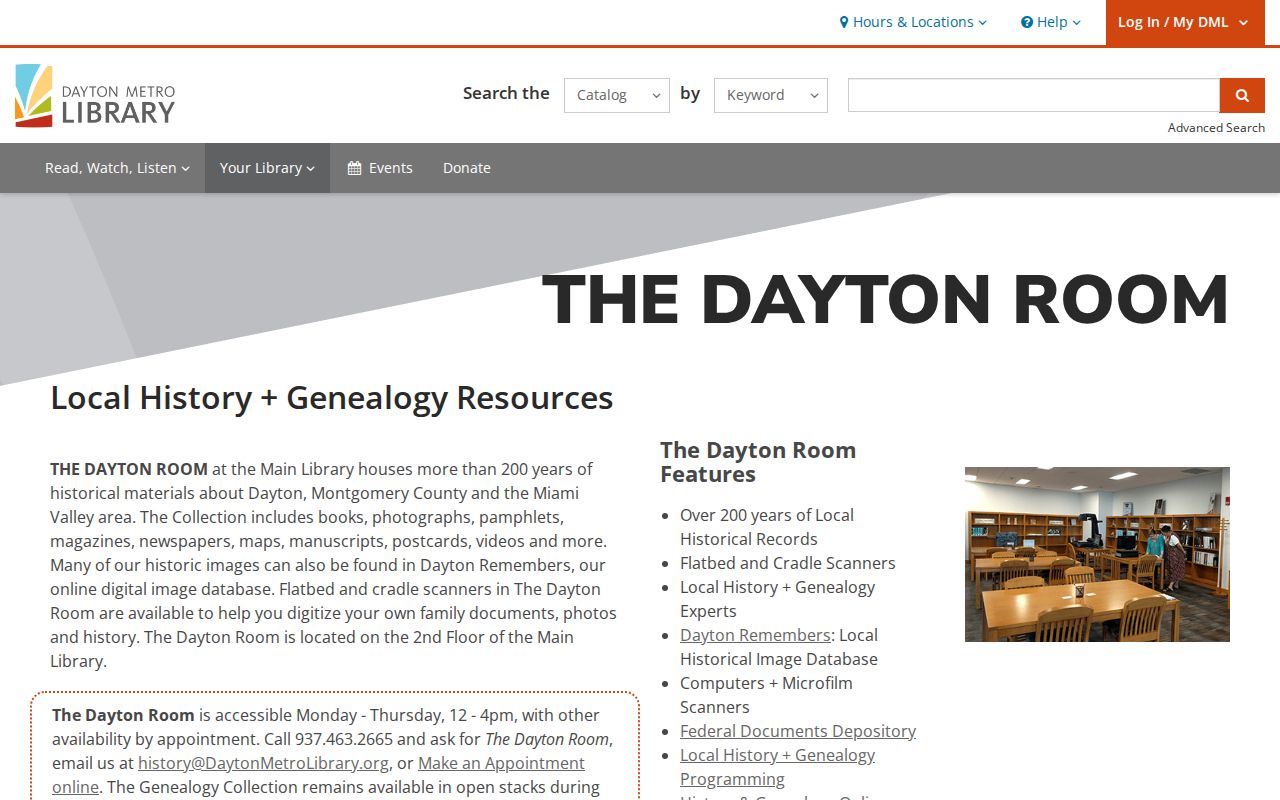
The room's scanners and staff consultation route matter when a directory entry must be compared with a newspaper, map, or an original volume.
Its more than two centuries of Dayton, Montgomery County, and Miami Valley materials include books, photographs, maps, newspapers, manuscripts, and audiovisual items. On-site databases add Fold3, HeritageQuest, Ohio Death Certificate Index, Ohio Memory, Sanborn maps, and Ancestry Library Edition, which the library states is available only at library locations. That mix makes the Dayton Room a useful counter and archive channel when the web copy is incomplete.
Digitized Montgomery County City Directories
The digitized 1876 Neder directory gives a period view of Dayton names, streets, public officers, businesses, the 1875 necrological record, and ordinances since 1873. Its description identifies George Neder and makes clear that the material is an historical publication, not a current-person record.
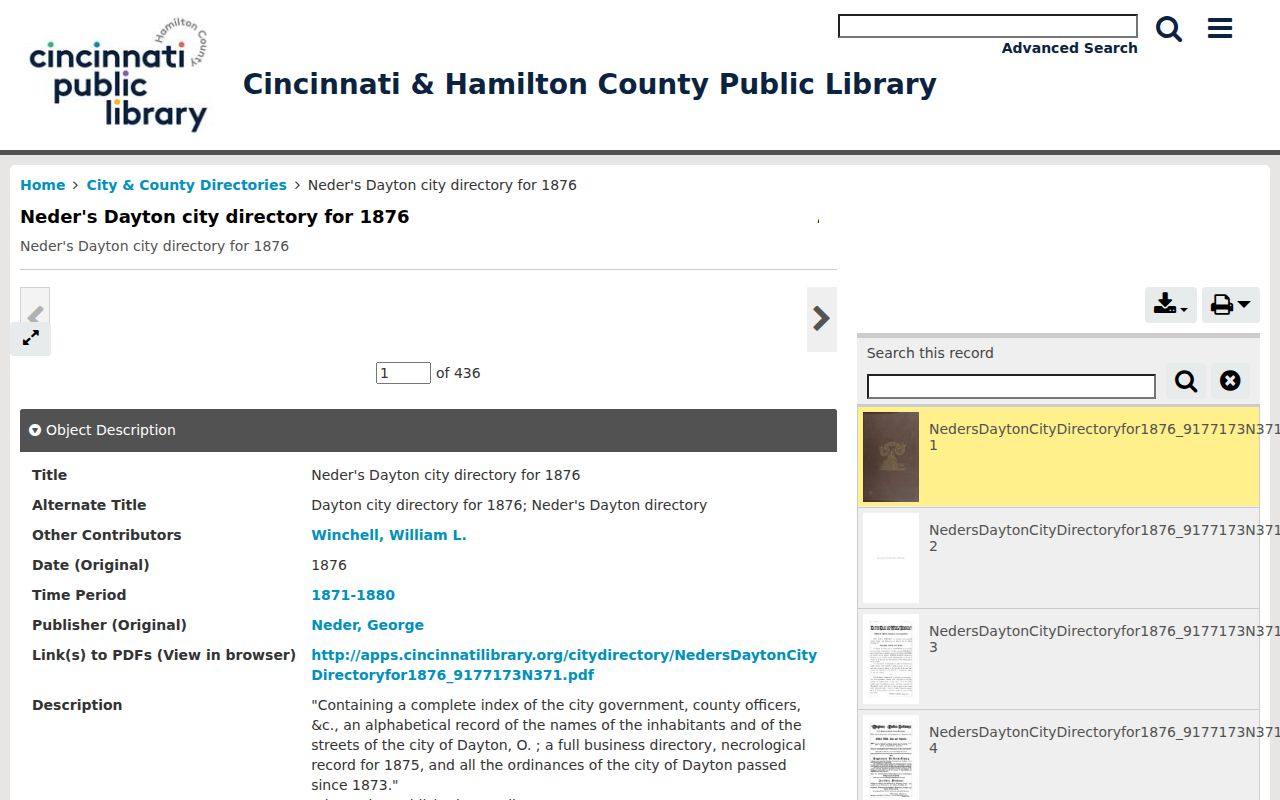
The online Neder volume is especially useful for testing a spelling, street wording, or business location before ordering more local research.
The earliest verified local anchor is Odell's 1850 Dayton directory catalog record. It documents an original title and an in-library Montgomery County Chapter OGS reprint. The Cincinnati collection also supplies digitized Williams volumes for 1856-57 and 1860-61, so a name found in one era can be checked against a later edition without pretending that the shelf is continuous.
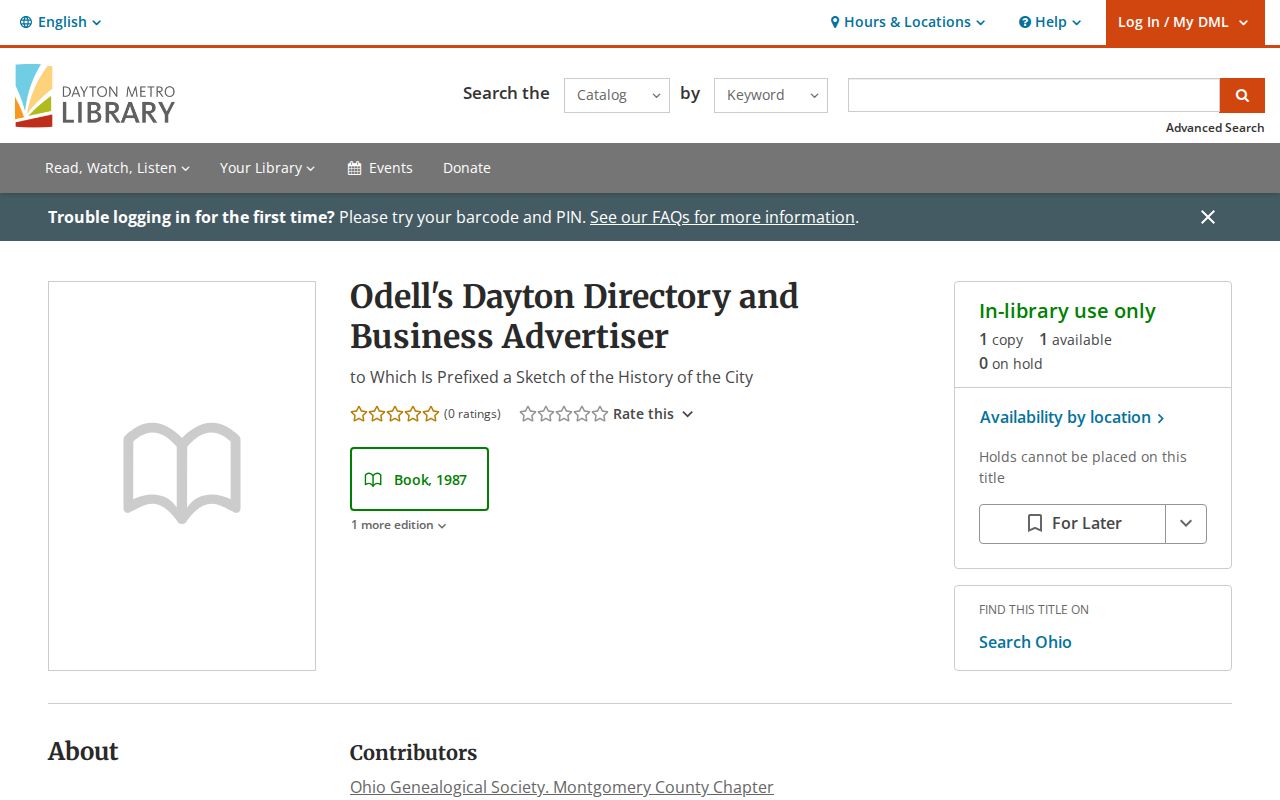
The Odell catalog image anchors the first verified Dayton edition and supports careful citation of its title and year.
Montgomery County City Directory Decoding
Read an early entry as a compact local description. The inspected Odell material indexes an individual or household name and can add an occupation or status, such as farmer, blacksmith, or carpenter. A residence or business location may be a neighborhood, establishment, cross street, or corner rather than a modern number. Preserve the edition and title-page context with the transcription. A familiar street address should never be supplied when the printed entry does not give one.
| Name | Alphabetically indexed person or household wording, including spelling as printed. |
|---|---|
| Occupation or status | A period descriptor that can distinguish similar names, but is not identity proof by itself. |
| Residence or business location | A number, street, cross street, corner, neighborhood, or establishment description. |
| Edition context | The title, publisher wording, and year attached to that particular volume. |
| Printed limitation | Only facts actually printed in the edition, with no inferred family relationship or property interest. |
- Criss-cross directory
- An address-first volume or section used to move from a street location to a listed name for that edition.
- Householder index
- An alphabetical arrangement that helps locate a named household before checking its address wording.
- Abbreviation key
- The volume's own explanation of shortened terms. Photograph or transcribe it before expanding any abbreviation.
Montgomery County Haines Directory Clues
Haines Dayton City & Suburban Criss-cross Directory is the documented local address-to-name route, but it is listed for in-library use and its public record does not expose a complete year run. Start with the exact street form printed in the target era, then ask staff whether the needed edition is present. A criss-cross result is tied to that edition and address, not a statement about every person connected with the property.
For a modern parcel or current ownership question, the Montgomery County by-street record trail uses Auditor, Recorder, and GIS sources rather than rebuilding the historical shelf. Keep the Haines volume as a period clue and test it against an independently dated record.
Note: The in-library restriction is useful information, because it directs the searcher to the counter instead of toward an unverified online substitute.
Montgomery County Directory Census Pairing
Directories narrow the years between federal census schedules. Start with one confirmed edition, carry its exact name and address language into the next available edition, and then compare the result with the census schedule nearest in time. Federal census schedules are public through 1950. The purpose is to test continuity, not to force a household conclusion from a single match.
- Record the name, location wording, occupation or status, edition, and page from the first directory hit.
- Check the closest available earlier and later volumes for spelling, address, and status changes.
- Use the Haines address-first material when its relevant edition is available at the library.
- Pair the directory year with the nearest public census schedule and compare household details cautiously.
- Use a deed, tax record, obituary citation, or Probate record only for the separate fact it confirms.
A disappearance can mean a move, a death, a variant spelling, an omitted listing, or an unavailable edition. It does not answer itself. When a historical directory result needs a present-day record check, use the separate Montgomery County resident lookup routes for the question being verified.
Montgomery County Obituary Cross-Checks
The Dayton Obituary and Genealogy Database, known as HOBITS, is a citation-level companion to a directory year. Its indexed obituary and death-notice runs include 1850-1880, 1897-1898, 1900, 1903-1918, 1920-1939, 1951-1957, 1965, and 1985-present, with additional years being indexed. It also includes named local material such as the 1930s Our Forefathers column, World War II service notes, selected marriage notices, and Gedenk Blaetter.
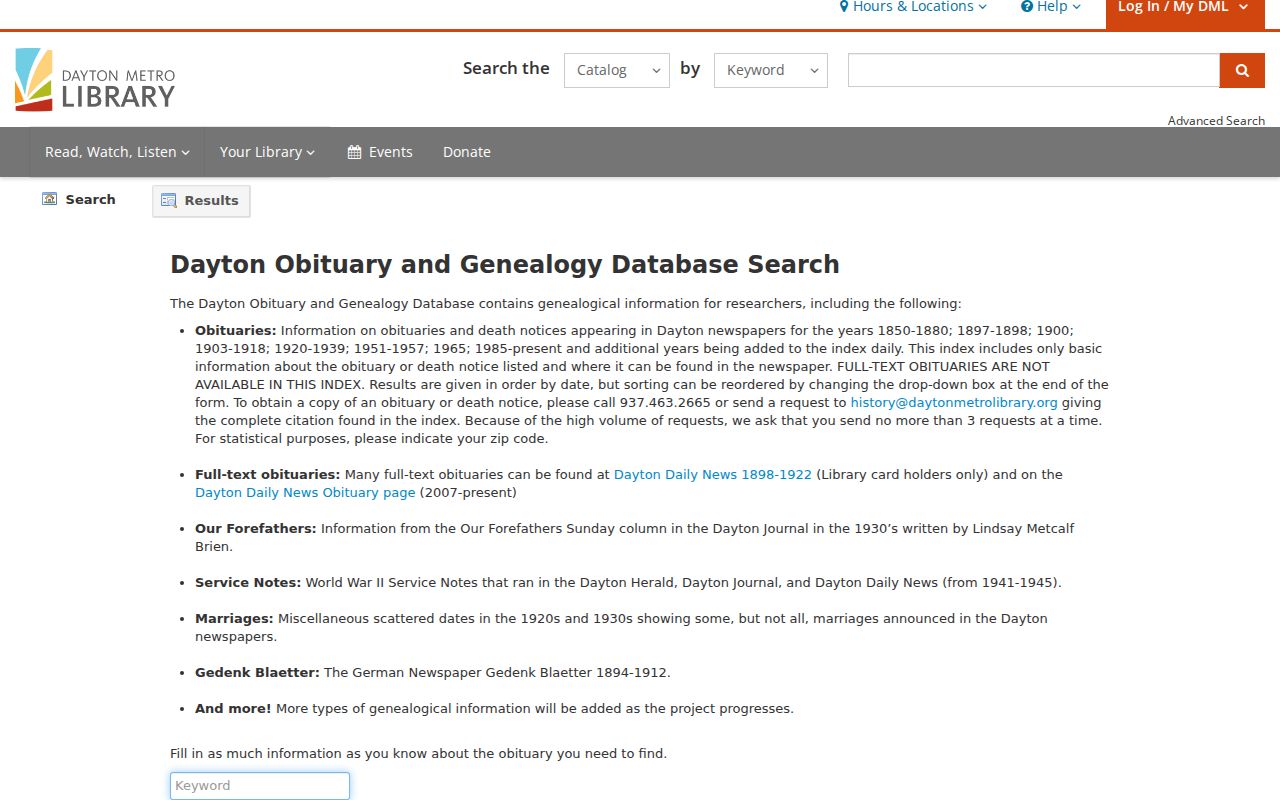
HOBITS returns a citation instead of full obituary text, so the citation should be saved exactly before a copy request.
The library asks for the complete citation when requesting a copy at history@daytonmetrolibrary.org or 937-463-2665, limits requests to three at a time, and asks for a ZIP code for statistics. A death notice can provide timing, relatives, or an address lead, while a directory supplies a dated local listing. Neither source should be expanded beyond what it actually records.
Montgomery County Directory Timeline
These dates are verified collection anchors, not a claim of uninterrupted publication or complete local availability. They provide useful checkpoints for a historical city directory search.
- 1850: Odell's Dayton Directory and Business Advertiser appears in the local catalog record.
- 1856-57 and 1860-61: Williams Dayton volumes are available as digitized historical copies.
- 1876: Neder's directory records inhabitants, streets, business material, officers, and local reference matter.
- 1899/1900-1908/09: Dayton volumes are identified within Wright Brothers materials.
- From 1995: R.L. Polk Polk City Directory, Dayton, Ohio appears in the Dayton Metro Library catalog.
Montgomery County Digitization Update
Historical access continues to change, so collection status should be checked before a research trip. In June 2026, local reporting said the complete Dayton Jewish Chronicle collection was being scanned through Ohio History Connection. Wright State Special Collections and Archives also reported preservation and digitization support in 2025. Its reading room was reported closed for facility upgrades through September 2026, making digital collections and research requests the appropriate route during that period.
Dayton History is another appointment-based research option for regional social, cultural, religious, political, and economic collections. Its staff can clarify collection and research access. A digitization announcement adds a possible source path, but it does not replace checking the actual collection, edition, and access rule before drawing a conclusion.
Note: For a missing directory year, ask the library or archive about its catalog, shelf, microfilm, and research-request routes before treating the gap as evidence.