
Montgomery County Resident Lookup Records
No single county list establishes who is at a particular address. The Auditor can connect an owner and tax-mailing relationship to a parcel. The Recorder can connect named parties to recorded instruments. Court, marriage, historical-death, voter, business, and license sources answer narrower questions. A resident lookup is strongest when it begins with the record most likely to contain a stable identifier, then uses a second independent detail to confirm the match.
| Record | What It Confirms | Where | Access |
|---|---|---|---|
| Parcel and tax record | Owner or tax-mailing relationship, parcel, legal description, and possible deed reference | MCRealEstate | Public read-only portal; owner does not identify every person at the address. |
| Recorded instrument | Named party role and a land or document trail | Recorder RISS | Guest index route and Recorder counter channels. |
| Court docket | Party, case number, court, filing context, and docket entries | Clerk PRO or Probate Court | Some material is redacted or confidential; certification is in person. |
| Vital or historical index | Marriage lead, death-source lead, or a date-specific family-history fact | Probate, Public Health, ODH, or Ohio History Connection | Index, certificate, and archive channels are different. |
| Voter, business, or license record | Registration/precinct status, entity filing, or credential status | Ohio state systems | Protected data and record-specific limits apply. |
Choose the source from the question: property, court, vital event, voter registration, business filing, or license status. A business-contact address is not evidence that a person lives there.
Montgomery County PRO Name Search
Clerk Public Records Online, or PRO, is the county court route for Municipal, Common Pleas General Division, Domestic Relations, and Second District Court of Appeals matters. It is a convenience portal, not the certified court file. Search by a party name or, when known, a case number. Narrow a broad name with the portal's court, case type, date, or other available controls because a search returns only the first 1,000 records.
Opening a case ties a name to a case title, number, court, and docket rather than to a current address. Filed images are generally redacted and normally appear within 48 to 72 hours, but some documents are unavailable or confidential. It is a lead for a specific court record, not proof of identity.
| PRO control or result | Use in a careful search |
|---|---|
| Party name | Try a full name and an established variant, then add a limiting parameter. |
| Case number | Use this precise identifier when it is known. |
| Court or case category | Keep the result in the portal's covered court context. |
| Docket entries | PRO states that these match the official docket entries. |
| Document images | Read them as redacted online images, not as a promise that every filed document is displayed. |
For a certified copy or certified docket, visit the Clerk in person. Public material that is not online may be viewed in redacted form at Clerk offices during normal hours. Protection orders, sealed records, juvenile matters, adoption-related records, and other confidential categories need custodian confirmation rather than repeated search attempts.
Verify a Montgomery County Resident
Same-name mistakes are common in a resident lookup. Keep the first source's stable fields before opening another one. For a property result, preserve the parcel ID, legal description, owner or mailing information, and deed reference. For a court result, preserve the case number, party role, court, and filing date. A directory or obituary result needs its edition, citation, year, and page. Those details make it possible to compare records without assuming that two matching names belong to the same person.
- Choose one official starting point. Use MCRealEstate for a property question, RISS for a recorded-name question, PRO for a covered court case, or Probate for an estate, marriage, or name-change matter.
- Write down the stable identifier from that result. A parcel's legal description and a case number are stronger than a name alone.
- Check a second independent characteristic, such as a full or variant name, a date, an address or legal description, a spouse or relative, a court role, or a time period.
- When a formal record is necessary, ask the actual custodian for the appropriate copy. Do not ask a clerk to decide whether two complex record trails describe the same person.
- Docket
- A court's running list of entries and actions in one case.
- Index and image
- An index points to a record. An image is a view of the filed document, which may be redacted or unavailable online.
- Certified copy
- A copy issued or certified by the record custodian for an official use that calls for certification.
- Legal description
- The lot, subdivision, tract, or township description that identifies land more reliably than a changing street number.
Note: A missing result can reflect a name variation, a record cutoff, trust or entity ownership, a sealed file, or a protected address.
Montgomery County Vital Record Routes
Vital research has separate current and historical paths. Public Health Dayton-Montgomery County Office of Vital Statistics handles local birth and death certificates, while the Ohio Department of Health provides a statewide route. The local office's current form lists certified birth, death, and fetal-death copies at $23 each, and records Ohio births from 1908 forward and Ohio deaths from 1909 forward. The state certified-copy fee set by Ohio Administrative Code 3701-5-03 is $12, plus specifically authorized additions. Confirm the current custodian instructions before ordering.
Ohio Department of Health Vital Statistics provides the statewide consumer certificate and order path. The ODH route is for current certified Ohio records, while a historical index is a separate research route. Ohio History Connection's death index covers ODH death certificates for 1913-1944 and 1954-1970, with other listed historical series. It is not the office issuing a current certificate, and its historical copy process is separate.
The Montgomery County marriage-license case search is the local starting point for marriage records.
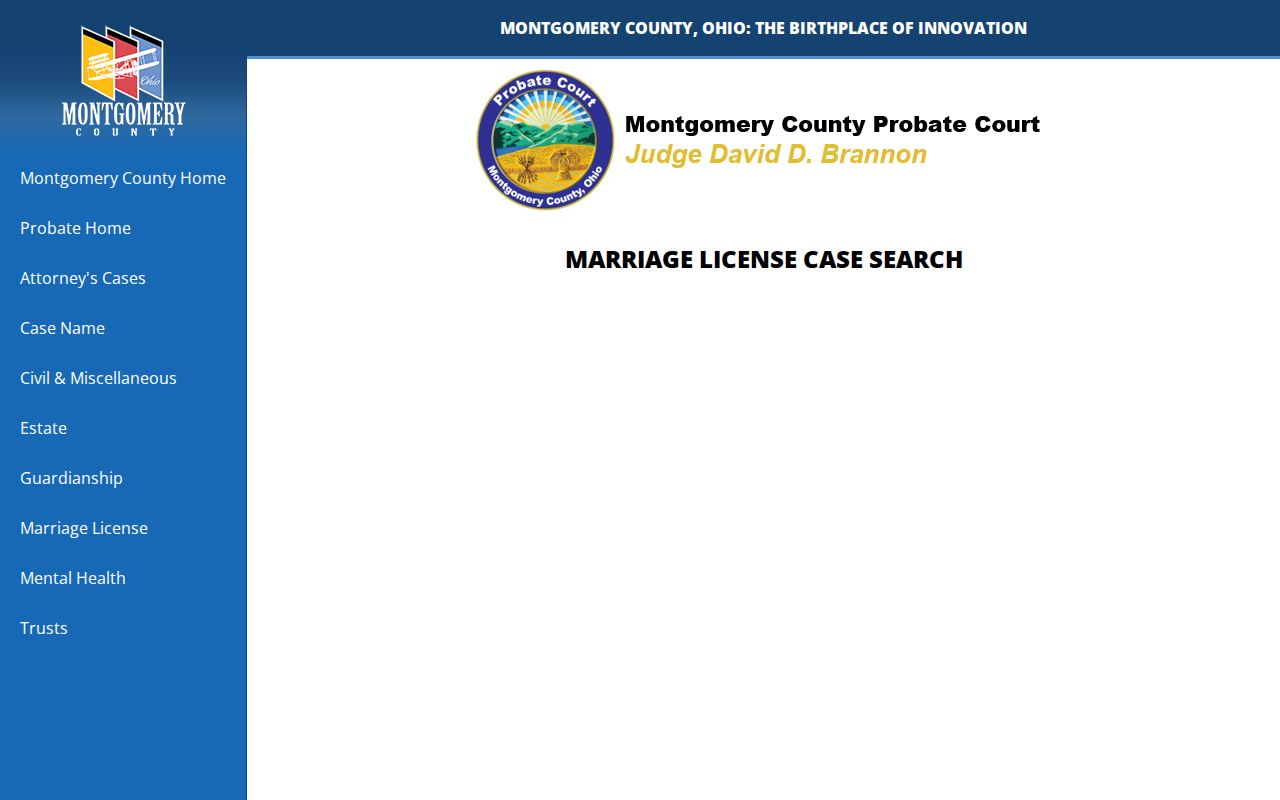
Probate Court is also the channel for marriage certified copies. Its form accepts a volume and page or case number when available, both applicants' complete names, ceremony date, copy count, contact information, payment, and a return envelope for mail requests. The form lists $2 per certified copy. The Records Center and Archives holds marriage records for 1803-1959 and directs later records to Probate, while its historic divorce route ends in 1949 and later decrees belong with the Clerk.
The Probate Court case-search page is the separate Montgomery County route for estates, guardianships, name changes, adoptions, and other Probate matters.
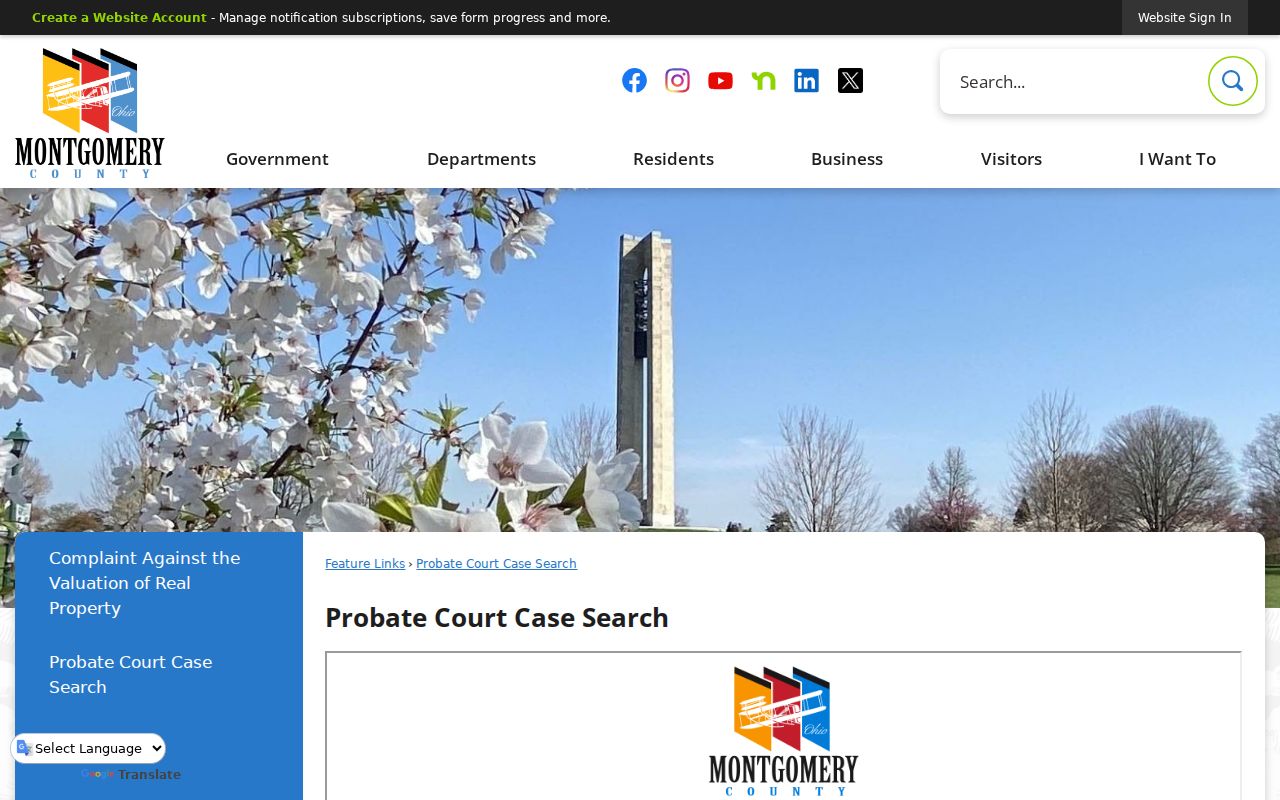
The public court path is updated daily, but adoption and mental-health records are not readily available. For a certified copy or a record-access question, use the Probate clerk's phone or counter channel rather than relying on a portal result alone.
Resident Lookup Beyond County Courts
County PRO does not search federal cases. PACER is the federal court system for the Southern District of Ohio and other federal courts. It has its own registration, document, search, and fee rules. Keep a federal case within PACER and a county case within PRO. In either system, align the name, court, case number, party role, filing date, and docket context before treating a hit as relevant to a Montgomery County resident lookup.
The PACER image marks the separate federal route rather than an extension of the county portal.
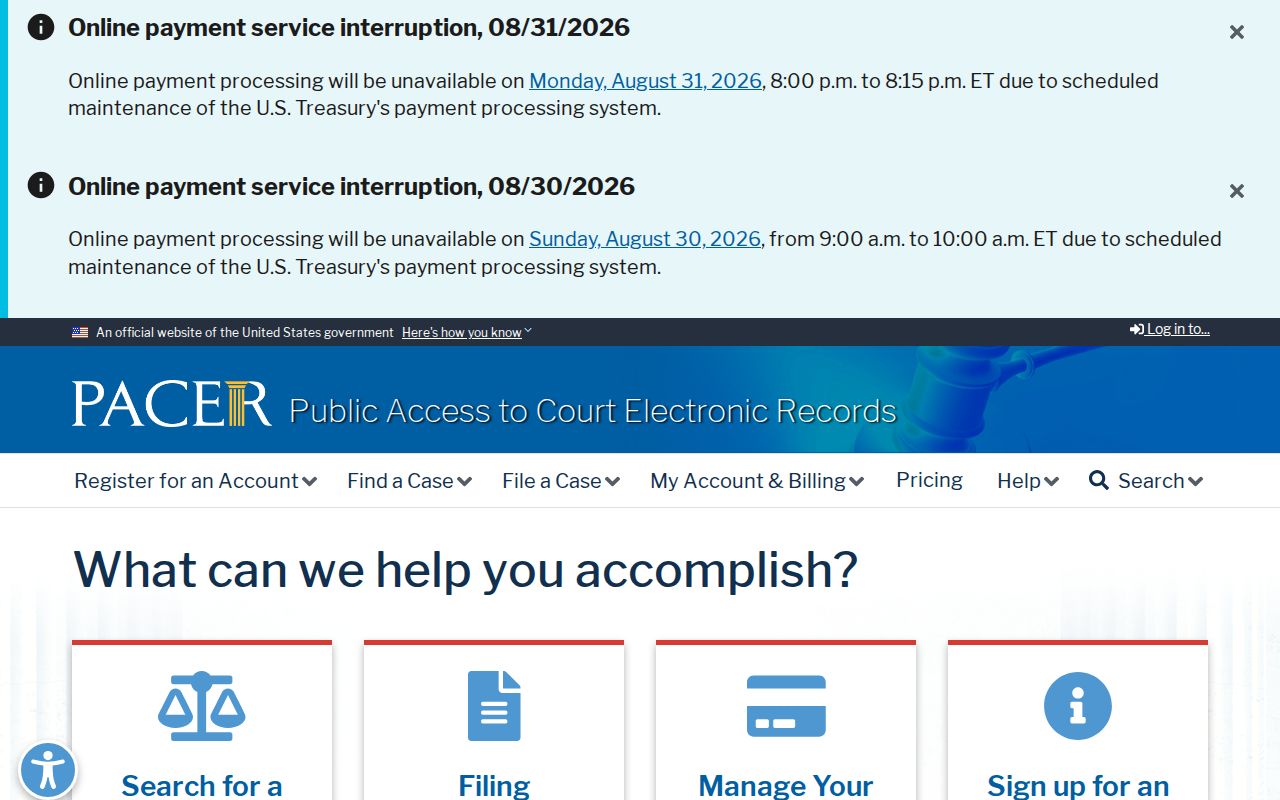
Federal Bureau of Prisons information is a separate custody lead, not a local address record or a complete criminal-history record.
The Federal Bureau of Prisons inmate locator is the official federal custody channel.
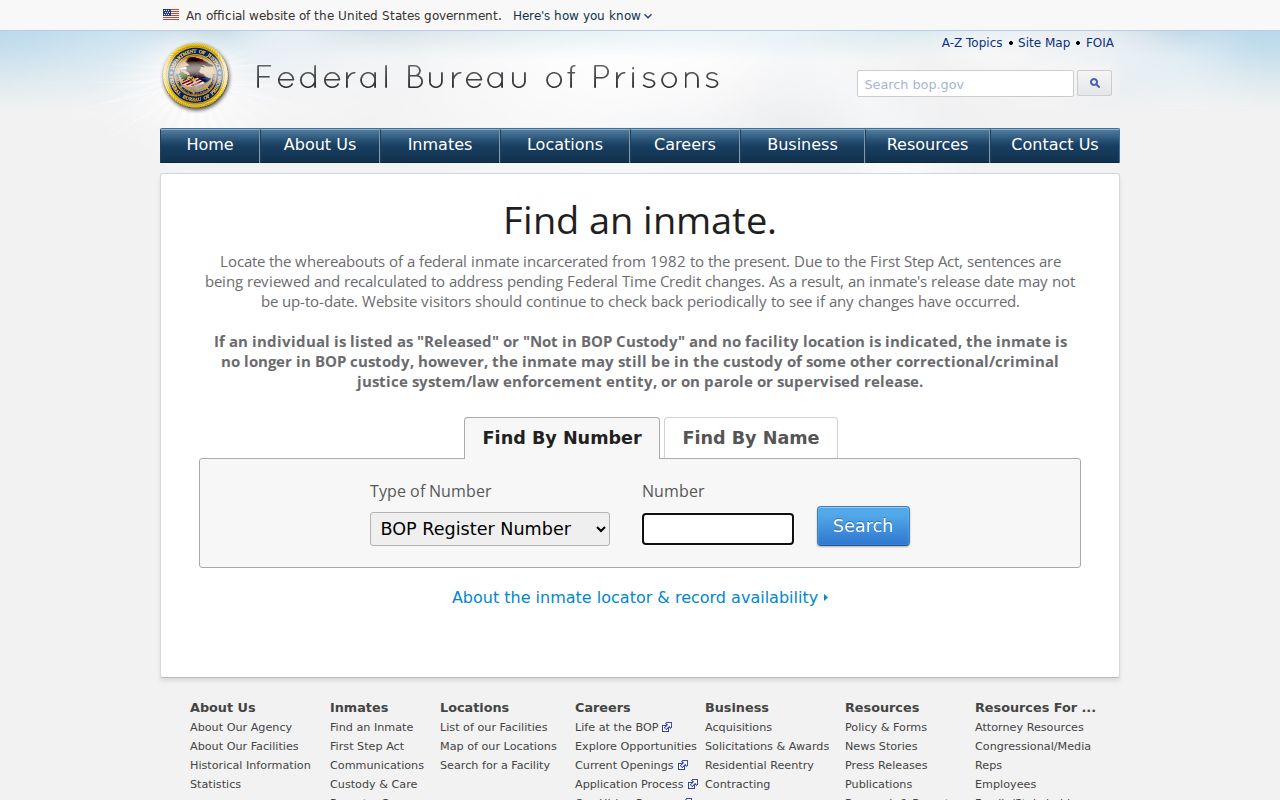
A result should remain limited to what the federal source states. It does not establish who else is connected with an address or prove a present location outside the system's own status information.
Ohio Voter Lookup for Residents
Ohio My Voter Information requires a first name, last name, and county. Select Montgomery County, submit the exact-name search, and use the follow-on street selector only when the system offers it. The tool checks registration and locates precinct and polling-place information. It is designed for an individual's registration lookup, not for browsing a street or an entire block.
For a nonmatch, the state suggests trying a formal or derivative first name, a former last name, or a previous Ohio address. The Montgomery County Board of Elections voter page is the local channel for registration corrections, record questions, sample-ballot information, and polling-place help. Social Security numbers, driver-license and state-ID numbers, phone numbers, email addresses, confidential records, and other protected data are excluded under R.C. 3503.13.
Montgomery County Business Record Checks
A business or credential trail can help distinguish people with similar names, but it has a narrow purpose. Ohio Secretary of State Business Search shows entity filings, status, filing history, statutory-agent information, and business-contact details. Ohio eLicense shows board-specific credential information such as a public name, credential number, type, status, dates, and published discipline fields. Check the responsible board when the exact credential matters.
Neither source is a personal-address directory. Use the displayed entity or credential facts as corroboration, then return to the appropriate county record for land, court, vital, or archive questions. RISS also has a UCC index type, and the Recorder's published schedule lists a $20 UCC search with no fee for findings, but that is a document inquiry rather than an identity verdict.
Montgomery County Records Request Route
When an online search does not supply the responsive record, direct a narrow request to the custodian that holds it. Ohio's Public Records Act, R.C. 149.43, gives any person a route to qualifying nonexempt government records. Name the record type, date range, person or address, parcel or case number, requested format, and whether an estimate is wanted before copying. The law uses prompt and reasonable-period standards, not one fixed response deadline.
The county's public-records routing page sends birth and death requests to Public Health Dayton-Montgomery County, marriage certificates to Probate, divorce decrees and court cases to the Clerk, and other records to their appropriate custodians. Older local trails may require the Records Center and Archives, a court counter, or Dayton Metro Library rather than another broad web query.
Montgomery County Resident Lookup Limits
Ohio Safe at Home is the state's address-confidentiality program for qualifying survivors. It can protect voter and real-property identifiers after the statutory process. R.C. 111.44 removes a confidential participant's residence address and precinct from public voter data, and R.C. 111.431 directs county property offices not to disclose protected property-identifying links after a valid notice. An absent or redacted result should never be treated as an invitation to find a protected address through another route.
Lawful use. Use Montgomery County records for personal, lawful research, family history, civic questions, or an estate trail. Do not use a resident lookup to stalk, harass, intimidate, or harm anyone; Ohio law addresses menacing by stalking in R.C. 2903.211 and telecommunications harassment in R.C. 2917.21.
For a wrong official record, contact the agency that maintains it. A commercial compilation has its own identity-verification and correction process, but it does not replace a correction from the actual public custodian. Recorded documents and court files can also carry lawful redactions, so ask the custodian about the applicable authority instead of seeking an unredacted result.