
Starting a Montgomery County Resident Search
Montgomery County keeps no all-purpose list of every household. The useful record depends on the question. An owner or parcel question belongs first with the Auditor. A document or prior-owner question belongs with the Recorder. A court question belongs with the Clerk of Courts PRO system or Probate Court, and a historical household question may be better answered by the Dayton Room or the County Records Center and Archives. Each source shows a limited part of a resident trail. A property owner is not automatically the current occupant, and an old directory entry is evidence for its edition year rather than a modern address confirmation.
Use one stable detail at each stage. A parcel ID, legal description, recorded instrument number, case number, or exact obituary citation makes it far easier to tell one person from another with the same name. The Montgomery County residents directory is most useful when it connects those details rather than treating a single screen result as final proof.
- Search the Auditor's address, owner, or parcel record and save the parcel location, owner, mailing address, legal description, and deed reference.
- Use the deed reference or legal description in the Recorder's index to identify the recorded instrument and earlier parties.
- Use Clerk PRO or Probate only for the court category that fits the question, then keep the case number and party role.
- For a past household, compare a Dayton directory edition, census schedule, obituary citation, or archive record from the same period.
- Ask the actual custodian for a copy, counter review, or narrow public-records request when the online result does not answer the question.
Note: A precise record request names the custodian, record type, date range, names, address or parcel, and format wanted.
Montgomery County Offices Behind Resident Rolls
County offices divide the resident evidence by function. The Auditor maintains the property assessment and tax display. The Recorder maintains recorded land instruments. The Clerk maintains several court dockets, while Probate has its own estate and marriage functions. The Records Center and Archives supplies the deeper county trail when a current portal ends. Ohio's voter service is statewide, with the Montgomery County Board of Elections available for local registration questions.
Records Center and Archives
117 S. Main Street, sixth floor
Dayton, OH 45422
937-225-6366
The county's public-records routing page directs each record type to its actual keeper. Under the Ohio Public Records Act, Ohio Revised Code §149.43, qualifying records may be inspected during regular business hours and copied within a reasonable period, subject to exemptions and copy costs. A request does not open a protected court file, confidential voter item, or Safe at Home address.
MCRealEstate Connects Montgomery County Parcels
The Auditor's MCRealEstate address search is the practical beginning for a Montgomery County address. Enter the number and road name without a direction or suffix. The official walkthrough advises trying a spelling variant, such as 3rd and Third, if the first search fails. A matching summary places ownership and mailing information at the top, gives current and delinquent tax details lower down, and may offer a deed reference for the most recent sale. The public display is read-only, and its tax-year controls currently show 1980 through 2025, not the complete historic tax record.
The Auditor address form is pictured below. It is best read as a parcel locator before moving to recorded instruments or an archive series.
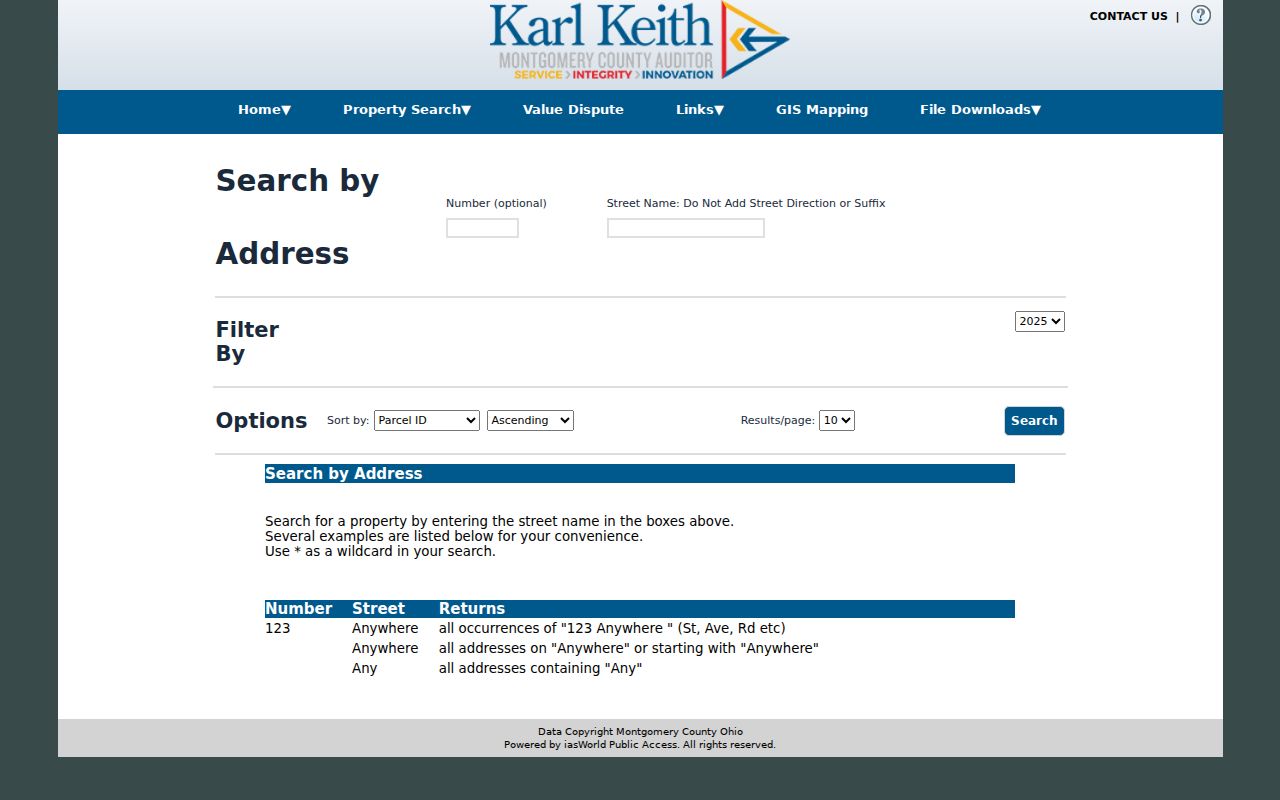
The result controls support a street-by-street sort by parcel location, but the owner field does not create a complete list of people at each property.
| MCRealEstate field | Use in a search | Format or result |
|---|---|---|
| Number | Optional street number | Enter only the number |
| Street Name | Primary address key | No direction or suffix; wildcard accepted |
| Tax Year | Choose displayed tax period | Any or 1980 through 2025 in the inspected list |
| Sort by | Order results | Parcel ID, owner, or parcel location |
| Owner name | Find a party's parcels | Use LastName FirstName, up to 25 characters |
- Parcel
- A defined unit of property used in the Auditor record.
- Situs address
- The physical parcel address, which can differ from the owner's mailing address.
- Legal description
- The lot, subdivision, tract, or township description used to tie land records together.
- Deed reference
- A link or citation that can lead from a property summary to the recorded instrument.
For a complete address chain, use the Montgomery County by-street directory after the parcel is identified.
Montgomery County Deeds Through RISS
The Recorder's Records Online Search, called RISS, supplies the instrument side of a Montgomery County resident trail. Its Guest route has By Name, By Type, By Municipality, By Subdivision, By STR, By Instrument, By Book/Page, By Fiche, By Pre 1980, By Date, and Certified Dates paths. The name form requires a last or firm name and lets a searcher choose Begins With, Contains, or Exactly, add a first name, choose index types, and narrow by start and end date. The office recommends dates to speed a search.
RISS is shown here at its recorded-document search entry point.
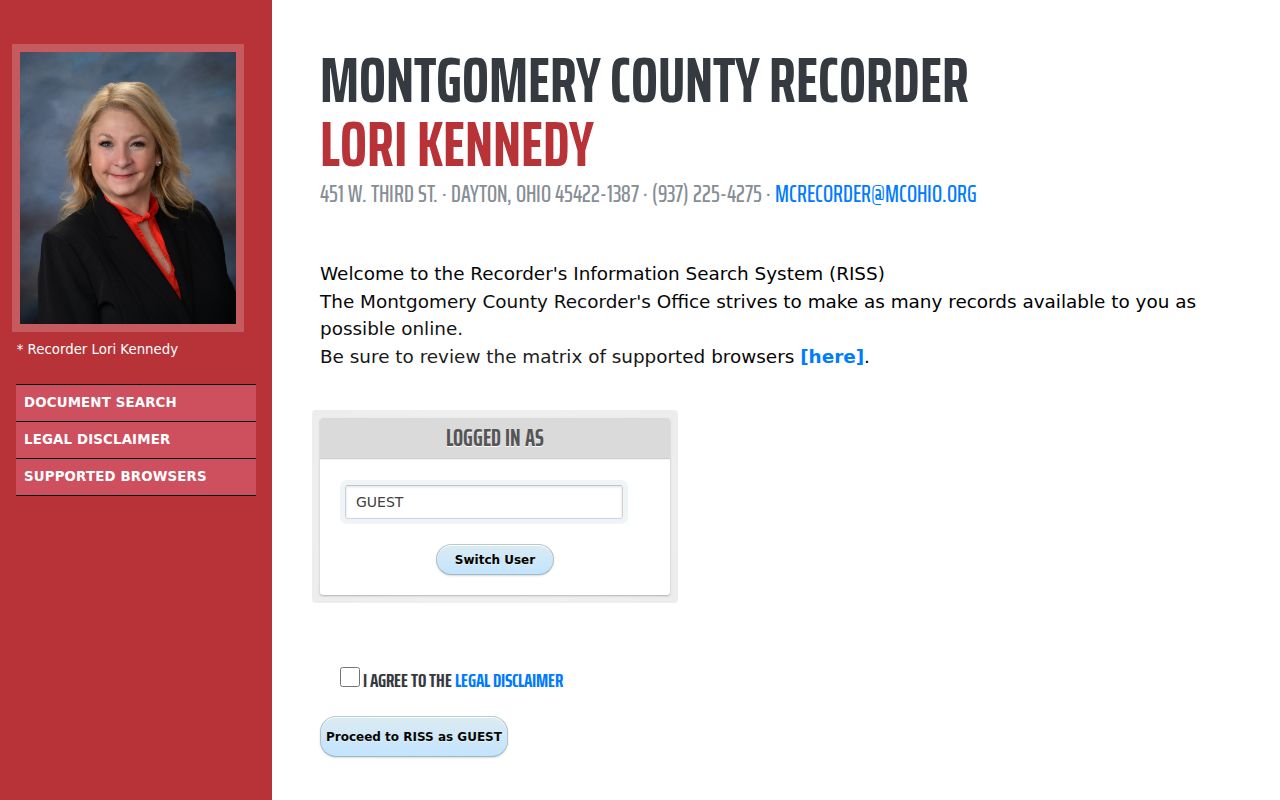
For a historic address, the legal description is often more dependable than today's house number. The Recorder's public terminals and Copy Center are the fallback when an image or index route is unavailable. Deed records reach 1805, while archive and office coverage must be confirmed for the year needed.
Practical record link. Keep the parcel's legal description constant while following grantor and grantee names backward through the deed chain.
Current Montgomery County Resident Sources
Current Montgomery County resident records answer different questions. The Auditor shows an owner and property relationship. RISS shows a named role in a recorded document. Voter tools are designed for individual registration and precinct information. Courts establish a party's connection to a case, not an address. Keeping those boundaries clear avoids turning a useful public index into an inaccurate household claim.
| Source | What it can show | Keeper | Access |
|---|---|---|---|
| MCRealEstate | Owner, parcel, situs and mailing information | County Auditor | Free public portal and office route |
| RISS | Named parties to deeds and other instruments | County Recorder | Guest index, terminals, Copy Center |
| My Voter Information | Individual registration, precinct, polling place | Ohio Secretary of State | Required first name, last name, county |
| Clerk PRO | Covered court docket and party information | Clerk of Courts | Public portal, counter for certified copies |
| Dayton community directory | Public organization contacts | City of Dayton | Online directory, not a membership roll |
Commercial compilations may repeat old address claims or merge records, but they do not replace the office that maintains the original. Use an official source to verify any lead.
Montgomery County Court Names in PRO
The Clerk of Courts Public Records Online system, or PRO, is the county's name-search route for municipal traffic, criminal, and civil cases; Common Pleas General Division cases; Domestic Relations cases; and Second District Court of Appeals cases. It is a convenience system rather than a certified case file. Docket entries match the official docket, while online document images are redacted and usually appear within 48 to 72 hours when available. The portal returns only the first 1,000 results, so a name search needs a court, date, case type, or other narrowing term when the result set is broad.
The PRO portal identifies its public-access limits before a search begins.
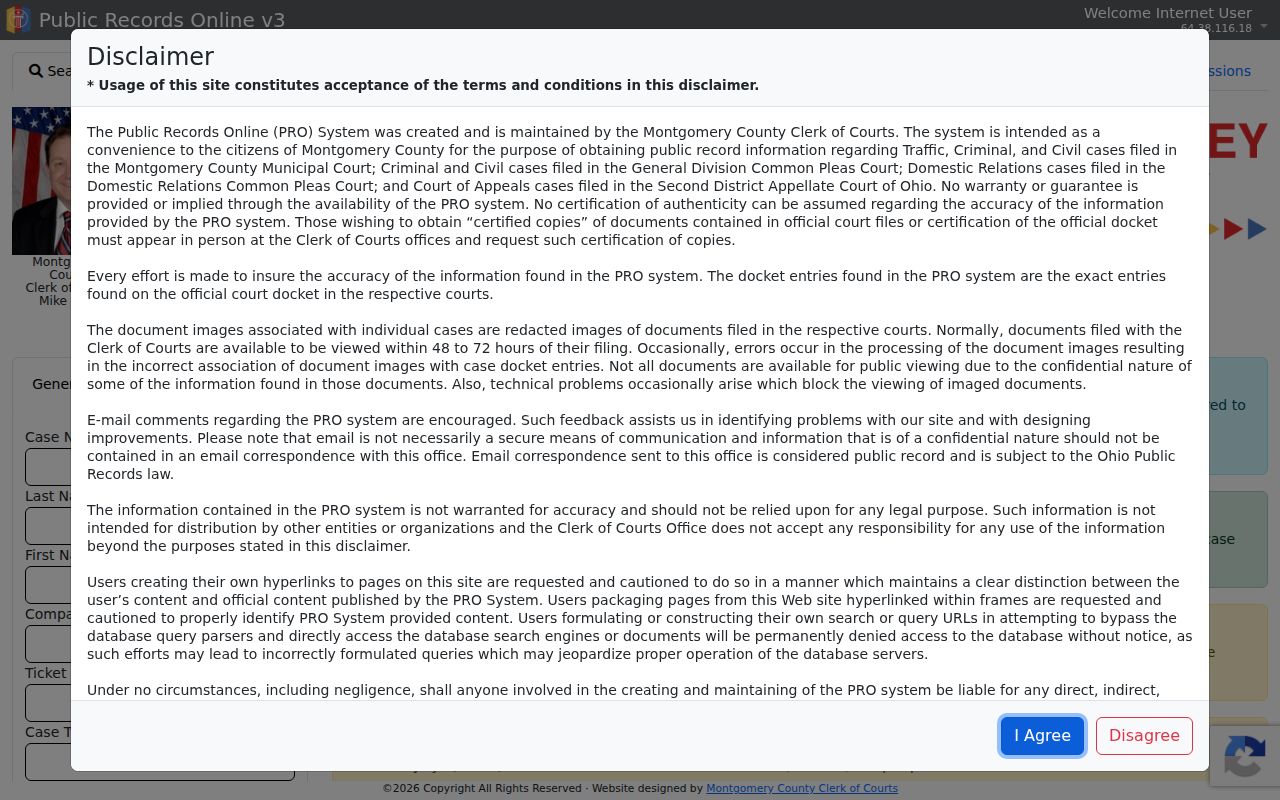
Retain the court, case number, case title, party role, filing date, and docket entry together. Certified copies must be requested in person. Probate is separate for estates, guardianships, marriage licenses, name changes, and other Probate jurisdiction, while federal cases are handled through PACER.
Note: A court docket is evidence of a case relationship, not proof that a party currently lives at an address.
Ohio Voter Information for Montgomery County
Ohio My Voter Information asks for first name, last name, and county, including Montgomery County, to return a match's registration, precinct, or polling-place information. The live form also offers a street-name selection after a search to narrow results. It is not an open countywide people list or a street roster. The local Board of Elections voter page is the right channel for registration corrections and questions.
Ohio Revised Code §3503.13 makes voter registration records public subject to exclusions. Social Security information, driver-license and state-ID numbers, telephone numbers, email addresses, confidential records, protected public-service-worker addresses, proof of citizenship, and other protected information are not part of the public display. A missing record may reflect a name or address change, a jurisdiction issue, an update, or a lawful confidentiality rule.
The statewide voter lookup is illustrated here as an individual-record tool.
Ohio Safe at Home can protect qualifying participants through a substitute address and removes protected information from public voter and property connections after statutory steps are completed.
Dayton Room Evidence for Montgomery County Families
The Dayton Room at Dayton Metro Library is the historical complement to Montgomery County's current indexes. Its Main Library collection covers more than 200 years of Dayton, Montgomery County, and Miami Valley material, including books, maps, newspapers, photographs, manuscripts, and directories. The room is on the second floor at 215 E. Third Street; it lists Monday through Thursday noon to 4 p.m. access, appointments for other access, and local-history help by telephone or email. Open genealogy stacks, microfilm scanners, local-history specialists, and on-site databases give a researcher options beyond a portal result.
Dayton Room research services are shown here.
The library's HOBITS obituary and genealogy index returns citations rather than full obituary text. For a copy, give staff the complete citation by email or phone, and keep requests to three at a time. That citation can then be compared against probate, property, or directory evidence.
Montgomery County Privacy Boundaries
Public access has limits in Montgomery County and Ohio. Safe at Home is the state address-confidentiality program for eligible survivors, administered through certified Application Assistants. Ohio Revised Code §111.44 protects a participant's residence address and precinct in voter data, and §111.431 directs several county property offices not to disclose protected real-property links after a valid notice. Redacted court records and protected voter fields are likewise not gaps to work around.
Lawful personal use. Montgomery County records may support family history, estate research, civic questions, or verification with a custodian. Do not use them to stalk, harass, intimidate, or harm anyone.
Ohio's menacing-by-stalking law is R.C. 2903.211, and telecommunications harassment is R.C. 2917.21. Ask the record custodian about a redaction or correction route instead of attempting to locate protected information.
FAN Protects Montgomery County Deed Records
The Recorder's free Fraud Alert Notification system, called FAN, is a useful property-record check. A participant can choose mail, email, or text alerts whenever a document is recorded and receives an instrument number to check in RISS. An alert can reflect an ordinary filing, such as a mortgage release, rather than fraud. When a document looks unfamiliar, confirm the instrument with the Recorder rather than relying on a solicitation or a secondary description.
The Recorder's FAN information explains the notification choices.
The Recorder advises people who believe a document is fraudulent to contact the office promptly. Its published process may involve Recorder review, a Prosecutor referral, and an Affidavit of Facts Relating to Title.
Montgomery County's Long Archive Reach
The dates explain why Montgomery County research often moves beyond a current web screen. The Records Center and Archives lists original-owner tract records from 1801 through 1830, tax lists from 1803 through 1983, marriage records from 1803 through 1959, deed records from 1805 into the twentieth century, and wills and estates from 1803 through 1983. Its detailed collection guide also identifies inactive-elector lists from 1887 through 1928, naturalization certificates from 1904 through 1936, and building-inspection permit series from 1947 through 2002.
Those ranges are a shelf-and-staff-retrieval route, not a promise that every item is digitized or indexed by name. Call the Archives with a target year, name, address, parcel, or series before visiting. Its staff retrieval process and the Recorder's office records can overlap, so the proper channel depends on the document type and date.
Montgomery County Records Since 1803
Montgomery County was created in 1803, and the Records Center and Archives reports access to county records going back to that year. Original-owner tract records reach 1801 through 1830, marriage and tax material begins in 1803, and deeds begin in 1805. The local record trail changes offices and formats over time. The Recorder uses computer indexing, microfilm, and images, while archival staff retrieve older holdings rather than offering open shelf browsing. This is why a failed online search is a signal to switch channels, not a reason to assume the record never existed.
The Ohio Department of Health is the current vital-record channel, while Ohio History Connection's death index is a separate historical route. Its documented certificate ranges include 1913-1944 and 1954-1970, with a distinct copy process. County archives, Probate, the Recorder, and the library all cover different eras of a Montgomery County residents directory.
Note: The 1913 flood is important local history, but the collected sources do not establish destruction of a particular county record series.
Historical Montgomery County Directory Shelves
Dayton directories provide named, dated household evidence within the broader Montgomery County residents directory. Verified anchors include Odell's Dayton Directory and Business Advertiser from 1850, Williams volumes for 1856-57 and 1860-61, Neder's 1876 directory, 1899/1900 through 1908/09 Dayton volumes in Wright Brothers materials, and R.L. Polk directories from 1995 in the Dayton Metro Library catalog. Haines Dayton City & Suburban Criss-cross Directory is an in-library address-to-name title. The catalog does not establish a complete last printed year, so a staff or catalog check is the safe way to test a gap.
The Dayton Metro Library catalog record for Odell's directory documents the earliest verified local volume.
Directory years, occupation clues, cross streets, and a cited page can distinguish a person before a modern record is checked. The Montgomery County city-directory collections page gives the full historical-shelf method.